
Recovery System Basics: Parachutes, Ejection Charges, and Safe Landings
A practical overview of rocket recovery systems for students, covering parachute sizing, ejection charge testing, and competition-ready deployment.
Why Recovery Is the Most Important System
A rocket that flies perfectly but crashes on landing is a failed flight. In the American Rocketry Challenge, teams are scored on altitude accuracy and egg survival — both depend entirely on a reliable recovery system. A parachute that fails to deploy cleanly or a shock cord that snaps under ejection force can end a season of careful design work.
Recovery failures are also the most common cause of rockets that fall outside the flight-duration window. Your total flight time is roughly the sum of time-to-apogee and descent time. Time-to-apogee is primarily set by the motor and airframe mass. Descent time is set almost entirely by your parachute. A team that spends weeks tuning altitude but ignores parachute sizing will show up to competition with a score that misses on duration, not altitude.
This guide covers the fundamentals every student needs before their first competition flight.
How Ejection-Based Recovery Works
Most model and mid-power rockets use a motor-ejection recovery system. Here is the sequence:
- The motor burns out and the delay grain ignites
- The motor's built-in delay grain burns for a set number of seconds
- The ejection charge fires, pressurizing the body tube
- The nose cone separates, pulling out the recovery wadding, shock cord, and parachute
- The parachute inflates and the rocket descends at a controlled rate
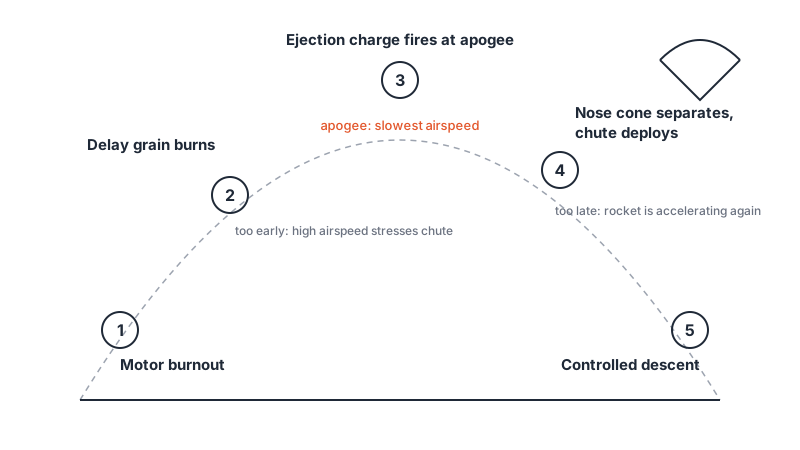
Each step in this chain must work reliably. A single failure point — tangled shroud lines, insufficient wadding, a friction-fit nose cone that is too tight — and the rocket comes down ballistic.
The delay in step 2 is critical. You want the ejection charge to fire at or just after apogee, when the rocket is moving as slowly as possible. Deploying the parachute well before apogee means it opens at higher airspeed, which stresses the canopy and shock cord and can push the rocket off its descent path. Deploying it well after apogee means the rocket has already accelerated back to significant speed before the chute opens. Read the delay number stamped on the motor designation and compare it against your simulation's predicted coast time from burnout to apogee. The process for doing that correctly is covered in matching the ejection delay to apogee.
Some teams add an electronic deployment system as a backup or primary trigger. That approach is covered in a later section.
Parachute Sizing and Descent Rate
Parachute diameter sets descent rate. The physics is governed by the drag equation. At the terminal descent velocity — the steady speed where aerodynamic drag exactly balances gravitational pull — the forces balance as:
mg = ½ × ρ × v² × Cd × A
Rearranging for velocity:
v = sqrt((2 × m × g) / (ρ × Cd × A))
Where m is the rocket mass in kilograms, g is 9.81 m/s², ρ is air density (approximately 1.20 kg/m³ at sea level on a standard day), Cd is the drag coefficient of the parachute (commonly taken as roughly 1.5 for the flat or lightly domed canopies typical of model rockets, though it varies with canopy shape, porosity, and how the area is measured), and A is the canopy area in square meters.
For a typical ARC rocket weighing 450–550 grams, working through that equation tells you that a 45 cm diameter parachute (area roughly 0.16 m²) produces a descent rate near 6–7 m/s, while a 60 cm parachute (area roughly 0.28 m²) drops that to around 4–5 m/s.
Why does this matter for scoring? Your descent time — the time from parachute deployment to landing — is the descent altitude divided by descent rate. If you deploy at 200 meters above ground level with a 5 m/s descent rate, you get roughly 40 seconds of descent time. Bump the descent rate up to 7 m/s and that drops to about 29 seconds. The ARC rules specify a total flight-duration window that changes each season — always check the current official rules for the exact target — but the general principle is constant: descent rate is your primary lever for adjusting total flight time once altitude is dialed in.
A slower descent rate also means more drift. On a day with 5 mph of surface wind, a rocket descending at 4 m/s can drift 50–80 meters from the launch point, depending on deployment altitude. A rocket descending at 7 m/s drifts much less in the same wind. There is a real trade-off between protecting the egg on landing and staying within the landing zone. Most ARC teams find a descent rate of 4–6 m/s is a reasonable starting range, then adjust based on their measured flight times and field conditions.
You can simulate descent rate and drift directly in OpenRocket before you buy hardware. See tuning descent rate in OpenRocket for how to configure parachute parameters in the simulation and compare predicted flight duration against the target window. Verify the simulation result against your actual flight data using the process described in altimeter flight data.
Buy or sew multiple canopy sizes and test them. Calculated descent rates are approximations. Real-world values vary based on canopy porosity, the packing density you achieve on a given day, and how cleanly the canopy inflates after deployment.
Shock Cord, Harness, and Swivels
The shock cord connects the nose cone to the body tube after separation. It absorbs the sudden jerk when the nose reaches the end of the cord after the ejection charge fires, and it must do this repeatedly across a full season of test flights and competition attempts.
For ARC-class rockets, use elastic shock cord — flat rubber bungee or tubular nylon elastic — at a minimum of 2–3 times the length of the body tube. A rocket with a 70 cm body tube should have at least a 140–210 cm shock cord. Many experienced teams go longer, up to 3 times body length, to give more time for the jerk to dissipate before the cord goes taut.
Attach the cord securely at both ends. At the nose cone end, thread through a screw eye or bolt epoxied into the base of the nose cone shoulder. At the body tube end, anchor to a bulkhead, centering ring, or motor mount — not to the body tube wall directly. A direct wall attachment can pull out under shock load. Epoxy all anchor points and inspect them before every flight.
A swivel between the shock cord and the parachute shroud-line bundle prevents the cord from twisting under the spinning rocket. Without a swivel, the parachute can wind up and tangle during deployment. Use a small but rated stainless steel barrel swivel — the kind available at fishing supply stores — and verify it opens and closes freely before each flight. A swivel that corroded shut over the off-season is useless.
Test your shock cord attachment before the first flight of the season by anchoring one end to a fixed point and giving the other end a sharp, hard tug. If anything loosens, re-epoxy and re-test.
Protecting the Recovery System from Ejection Heat
The ejection charge that separates the nose cone is a small black powder charge. It produces hot gas and burning particles. Without protection, those particles reach the parachute, melt synthetic fabric, and destroy it.
Wadding
Flame-resistant recovery wadding is the standard solution for smaller rockets. Place several sheets of wadding loosely between the ejection charge and the packed parachute before each flight. The wadding catches any burning particles and decelerates the hot gas before it contacts the canopy.
Use enough wadding to fill the tube from the motor forward bulkhead to the base of the parachute pack. Too little and particles get through. Too much and the ejection charge has to push too much mass before the pressure can separate the nose cone. Three to five sheets, loosely crumpled, is typical for a 38 mm body tube. Adjust based on your ground tests.
Nomex Protectors
A Nomex chute protector is a reusable, flame-resistant fabric sleeve that wraps around the folded parachute. It is more reliable than wadding for competition use because it is not consumed per flight and eliminates one preparation variable. If wadding quantity varies between your ground test and flight day, your results vary. A Nomex sleeve is always the same.
Nomex protectors are available in various sizes from rocketry suppliers. Select one that fits your canopy diameter and folds flat inside your body tube. Place it between the ejection charge side and the wrapped parachute on every flight.
Baffles
Some teams build a baffle — a section of tube with angled baffling plates that forces the ejection gas to change direction before it reaches the recovery bay. Burning particles tend to continue straight and embed in the baffle material rather than reaching the parachute. Baffles eliminate the need for wadding entirely but add weight and require accurate construction to work as designed. For a competition rocket where mass matters, evaluate whether the weight penalty is worth the reliability gain.
Electronic Deployment
Motor ejection is simple and does not require any electronics, which is why most ARC teams use it. Its limitation is that the delay is fixed at the factory and can only be trimmed within a narrow range. If your flight trajectory changes significantly from one test flight to the next — because you change mass, motor, or launch angle — the fixed delay may no longer land near apogee.
An electronic deployment system replaces or backs up the motor ejection charge with a small altimeter that detects apogee directly and fires a separate ejection charge at the right moment. The altimeter senses when the barometric pressure stops decreasing (apogee), waits a configurable delay, and triggers the charge. This approach produces more consistent deployment timing across varying conditions.
The trade-off: electronic deployment adds mass, cost, complexity, and a wiring harness that must be assembled correctly before every flight. It also requires a dedicated e-bay section in the airframe and proper bay venting, which overlaps directly with the static port considerations discussed in altimeter flight data.
For most teams new to ARC, motor ejection with a well-matched delay is sufficient. Electronic deployment becomes worthwhile when you have done enough test flights to know that ejection timing variability is limiting your consistency, and you are confident you can build and maintain the electronics reliably under competition conditions.
Ground-Testing the Ejection Charge
Never fly an untested recovery system. Before your first flight, perform ground ejection tests:
- Pack your recovery system exactly as you would for flight — same wadding or Nomex, same packing method, same nose cone friction fit
- Remove the motor and substitute a ground-test ejection charge of the same size as the motor's built-in charge, inserted in the motor mount
- Point the rocket in a safe direction with nothing in the flight path; anchor it so it does not fly up
- Run an ignition wire to a safe distance (at least 5 meters)
- Fire the charge and observe: did the nose cone separate cleanly? Did the parachute deploy fully? Did the shroud lines clear the canopy without tangling?
Run this test at least three times using the exact packing sequence you plan to use at competition. Consistency across tests is more important than a single clean result. If the nose cone does not separate reliably, reduce friction fit or increase the charge slightly. If the parachute does not unfurl, work through packing technique. If the shroud lines tangle, see the packing section below.
After ground testing, inspect the parachute for melted spots or char marks. If you find any, your wadding or Nomex protection is insufficient.
Packing Technique
How you fold and pack the parachute matters as much as the parachute itself. A poor pack is the single most common source of deployment failures on the field.
Our recommended method for competition reliability:
- Lay the parachute flat and untangle all shroud lines completely before touching the canopy
- Fold the canopy in half, then in thirds, creating a narrow strip
- Z-fold the strip so it fits the body tube diameter
- Wrap the shroud lines loosely around the folded canopy — do not cinch them tight, and do not let them loop over the top of the canopy where they can catch during inflation
- Place the swivel outside the canopy bundle, not wrapped inside it
- Place your Nomex protector around the canopy bundle or lay wadding sheets loosely over it
- Insert the packed assembly gently — do not compress it forcibly
Practice this packing method until you can do it consistently in under two minutes. On competition day, muscle memory matters. Designate one person on your team as the recovery packer and have that person do it the same way every time.
Common Recovery Failures
Understanding why recoveries fail helps you prevent them systematically.
Zippering. When a parachute deploys while the rocket is still moving fast, the sudden canopy inflation jerks the shock cord taut with enough force to split the body tube lengthwise — the cord "zippers" through the tube wall. This usually results from deploying before apogee. The fix is a correctly matched ejection delay and confirming that delay with simulation and test flights.
Tangles. Shroud lines wrapped too tightly around the canopy fold during packing can prevent the canopy from fully inflating. Partly inflated canopies produce higher descent rates than expected and are erratic in the air. The fix is consistent packing technique and verifying deployment in ground tests.
Early deployment. The ejection charge fires before apogee because the motor delay is too short for the rocket's burn-to-apogee time. This is a simulation and motor-selection problem. See matching the ejection delay to apogee.
Late deployment. The ejection charge fires well after apogee, after the rocket has built up speed in the downward portion of its flight. The canopy opens under higher load and the flight duration shifts shorter. This is the mirror of the early-deployment problem — the delay is too long for the trajectory.
Nose cone that does not separate. The friction fit is too tight for the ejection pressure available. Reduce friction fit until the nose cone separates cleanly every time in ground testing. Friction fit should be firm enough that the nose cone does not slide off when you hold the rocket upside down, but loose enough to separate cleanly in the ground test.
Shock cord failure. The cord snaps or pulls out of its anchor. This almost always comes from an undersized or improperly attached anchor, or a cord that has accumulated heat damage across multiple flights. Inspect the cord and attachments before every flight and replace at any sign of fraying, stiffening, or charring.
Checklist Before Every Flight
- Wadding or Nomex in place
- Parachute packed with lines untangled and swivel outside the canopy bundle
- Nose cone friction fit tested: firm but separates with moderate hand pressure
- Shock cord attached and inspected at both ends; no fraying or char
- Shock cord length is at least 2× body tube length
- Swivel opens and closes freely
- Motor ejection delay matches simulation-predicted burnout-to-apogee time
- Recovery setup is consistent with last successful ground test
Where to Go From Here
Recovery is not glamorous, but it is the system that brings everything else home safely. Parachute sizing, ejection timing, shock cord integrity, and packing consistency all feed directly into whether your flight duration falls inside the scoring window. Treat the recovery system with the same rigor you give to fin design and motor selection — it will affect your score just as directly.
For guided support connecting recovery setup, simulation, and flight-day routines, explore our ARC coaching classes.