
Designing 3D-Printed Rocket Fins: A Student Guide to Aerodynamic Stability
Learn how to design, print, and test 3D-printed rocket fins using CAD and iterative prototyping. A practical guide for ARC-track students.
Why Fin Design Matters in Competitive Rocketry
Fins are the primary stability system on any model or high-power rocket. In the American Rocketry Challenge, a poorly designed fin set can cause unpredictable flight paths, missed altitude targets, and broken eggs. Getting fin geometry right is one of the highest-leverage skills a student can develop.
This guide walks through the design-to-test cycle for 3D-printed fins, the same workflow our ARC-track students use in class — from understanding the aerodynamics, to choosing your print settings, to verifying stability before your first qualification flight.
Understanding Fin Geometry
For conventional flat fins, four geometry terms appear in every simulation tool and rulebook:
- Root chord — the length where the fin attaches to the body tube
- Tip chord — the length at the outer edge of the fin
- Span / fin height — how far the fin extends from the body tube; ARC rules use the term "fin height"
- Sweep angle — the angle of the leading edge relative to the body tube
ARC rockets vary widely, and some designs use nontraditional fin types such as tube fins. Treat these terms as vocabulary for reading rules, simulations, and CAD models, not as a universal design recipe.
Planform trade-offs. The overall shape of your fin — its planform — affects both drag and stability. A clipped-delta (trapezoidal) fin with a moderate sweep angle is the most common choice for ARC rockets: it gives efficient stability with relatively low drag and is easy to model in CAD. Elliptical planforms are aerodynamically efficient but harder to print cleanly and add little practical benefit at ARC flight speeds. Highly swept arrow-style fins reduce drag but shift the center of pressure forward more weakly per unit area, so you need more span to achieve the same stability margin. When in doubt, start with a trapezoidal fin and iterate from there.
How Fins Set the Center of Pressure
This is the physics that connects every dimension you draw in CAD to how your rocket actually flies.
The center of pressure (CP) is the point at which aerodynamic forces effectively act on the rocket body. Your fins contribute the largest share of CP location because they have the most exposed lateral surface area aft of the nose cone. When you increase fin span, or move the fins further aft, or increase root chord, the CP moves aft. When you reduce fin area, CP moves forward.
Stability margin is the distance from the center of gravity (CG) to the CP, expressed in body-tube diameters (calibers):
Stability margin = (CP location − CG location) / body tube outer diameter
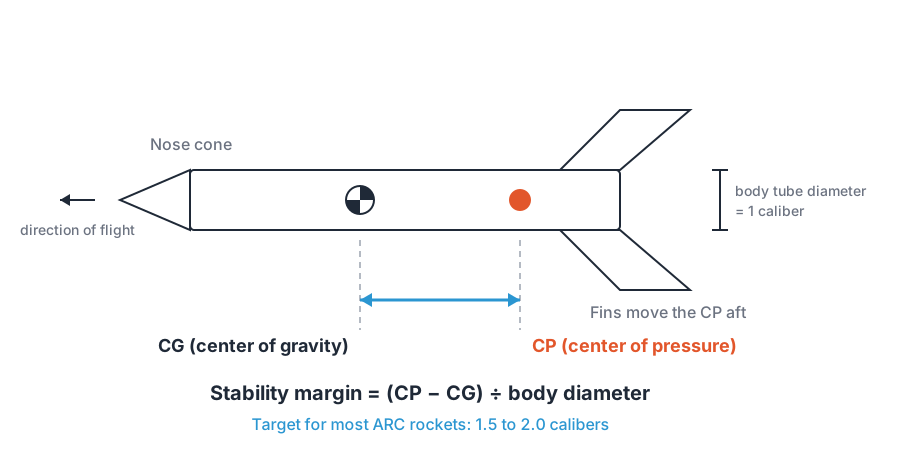
For the rocket to fly straight, CG must be forward of CP — that is, the stability margin must be positive. A margin below 1.0 caliber means small disturbances during flight can push the nose off-axis and the fins will not generate enough restoring force to recover. A margin above 2.5 to 3.0 calibers means the fins are generating so much restoring force that the rocket will weathercock aggressively into any crosswind, which costs altitude and makes flight-path prediction unreliable.
The practical target for most ARC rockets is 1.5 to 2.0 calibers of stability margin. You can check stability margin in OpenRocket in real time as you adjust fin dimensions — the CP marker on the design diagram updates immediately when you change a fin parameter. Do your stability checks there before committing any design to a print.
A common student mistake is increasing stability margin by simply making fins larger. Larger fins do move CP aft, but they also add mass and aerodynamic drag. A better adjustment, once you are in the right ballpark, is to move an appropriately sized fin set further aft on the body tube. An aft fin position achieves the same CP shift with less added drag and less added mass.
Airfoil Shape and Leading-Edge Geometry
A flat-plate fin produces lift and acts as a stability surface, but it also generates more pressure drag than a fin with a shaped cross-section. At ARC competition speeds — typically subsonic, in the 100–300 ft/s range — the aerodynamic gains from a full airfoil profile are modest, but a well-executed leading-edge treatment is worth the effort.
Leading-edge radius. A sharp or squared-off leading edge (what you get straight off a flat print) promotes earlier flow separation and higher pressure drag than a slightly radiused or beveled edge. For 3D-printed fins, you can approximate a rounded leading edge directly in CAD by adding a small radius (1–2 mm) to the forward edge of the fin profile, or by sanding the leading edge after printing. A blunt, flat leading edge is the worst option: it creates a larger separated wake and stalls more readily when the rocket flies at a small angle of attack, both of which add drag.
Fin thickness. Thicker fins are stiffer and more resistant to flutter and damage, but add weight and drag. For a fin with a 30–40 mm chord, a thickness of 3–4 mm at the root tapering slightly toward the tip is a reasonable starting point. Below 2.5 mm at the root, printed fins in PLA are noticeably flexible and prone to flutter. Above 5 mm, the weight penalty becomes significant for a competition rocket trying to hit a specific altitude target.
Trailing edge. A tapered or slightly pointed trailing edge reduces wake turbulence compared to a blunt cutoff. In CAD, taper the last 3–5 mm of fin chord to a thin edge. Do not rely on the slicer to interpret this correctly — model it explicitly in your fin profile.
Fin Flutter and Stiffness
Fin flutter is an aeroelastic instability: above a critical airspeed, aerodynamic forces couple with the fin's natural bending and twisting and drive a self-amplifying oscillation that can destroy the fin within seconds. The critical flutter speed depends on fin stiffness, fin geometry (span and chord), and material properties. Thicker fins with shorter span flutter at higher speeds. Thinner, longer fins flutter at lower speeds.
For ARC-class rockets, flutter is most likely to be an issue during the boost phase when velocity and dynamic pressure are highest. Two practical rules:
- Do not use fins thinner than 3 mm at the root in PLA or PETG unless the span is short (under 60 mm). Thin, long fins are the highest flutter risk.
- Increase infill, not just wall count, if you notice fin flex. A 20% gyroid infill provides good stiffness-to-weight in printed fins. Dropping to 10% to save mass can create a fin that flexes noticeably under hand pressure — that fin will flutter in flight.
After printing, do a simple flex test: hold the fin by the root chord and apply light lateral pressure at the tip. There should be no perceptible flex. If you can deflect the tip more than a millimeter with moderate thumb pressure, the fin is too flexible for competition use. Reprint with higher infill or greater thickness before flying.
Print Orientation and Layer Adhesion
How you orient the fin on the print bed determines where the weakest interfaces — the layer boundaries — fall relative to the loads the fin will experience in flight and on landing.
Flat on the bed places layer lines parallel to the fin face. The bond between layers runs across the span, so aerodynamic side loads are carried across strong layer interfaces. This orientation is the correct choice for simple flat-plate fins. The downside is that you cannot print a shaped airfoil cross-section this way; the fin will be a uniform thickness equal to however many layers you stack, and any leading-edge shaping has to be added post-print.
Vertical (fin chord along the Z-axis) allows full airfoil or beveled profiles because you are printing cross-sections of the fin shape layer by layer. However, the layer interfaces now run perpendicular to span — meaning that a hard landing or a flutter event can delaminate the fin along those planes. Use vertical printing only with 4+ perimeter walls and 20%+ infill, and reinforce the root with an epoxy fillet after mounting.
45-degree angle is a compromise that puts layer lines at an angle to both the aerodynamic and impact load directions. It requires more support material and usually produces a fin that is less consistent than either of the other orientations. Use it only when the fin geometry makes flat or vertical printing impractical.
The general recommendation: print flat for flat-plate fins, print vertical for shaped-profile fins, and always use at least 4 perimeter walls and 20% gyroid infill regardless of orientation. Weigh each fin after printing and target consistency within 1 gram across your fin set. Mass imbalance across fins causes roll torque and slightly asymmetric flight paths.
Material Choice: PLA, PETG, and ABS
PLA is the default choice for most student teams. It is dimensionally stable, easy to print at standard settings (205–220°C nozzle, 60°C bed), and produces consistent mass from print to print. The drawback is brittleness: PLA fins on a hard landing can crack through the root. For competition, print PLA fins and apply a thin coat of thin-viscosity cyanoacrylate (CA) or laminating epoxy to the surface after sanding — this seals the surface, adds modest impact resistance, and slightly stiffens the fin.
PETG absorbs impact better than PLA and survives harder landings without cracking. It is slightly more flexible, which can be an advantage (fin survives a landing that would snap PLA) or a disadvantage (higher flutter risk at thin gauges). PETG also tolerates warm conditions better than PLA — relevant if your rocket will sit on a dark launch pad on a hot day. Print settings: 230–245°C nozzle, 70–80°C bed.
ABS offers good heat tolerance and can be sanded and painted to a smooth surface, but it warps without an enclosure, and the layer adhesion on unenclosed printers is often worse than PLA. For most student setups, PETG provides ABS's advantages without ABS's warping problems.
Do not use TPU or other flexible filaments for structural fins. They are too compliant and will flutter at modest speeds.
Robust Fin Attachment
The fin-to-body-tube joint is the highest-stress location on the entire fin set. Fins fail at the root before they fail anywhere else. How you attach them determines whether your fin set survives a typical competition season.
Slot-through attachment is the strongest method: the fin root extends through a slot cut in the body tube wall and butts against the motor mount tube inside. This transfers load from the fin into the internal structure rather than relying solely on the external bond. If your airframe allows it, design your fins with a root tab that is 3–5 mm longer than the body tube wall thickness.
Surface-mounting with large fillets is the most common method for cardboard tube airframes where slotting is impractical. Use 5-minute or 30-minute structural epoxy (not CA, not white glue) for the initial bond. After the epoxy cures, apply a second fillet of thickened epoxy (mix with microballoons or cab-o-sil) on both faces of each fin-body junction. The fillet should be at least 3–4 mm in radius and run the full length of the root chord. Fillets dramatically increase the pull-out strength and reduce stress concentration at the root edge.
Rail-slot printed bases work well when your design prints the fin with an integrated mounting tab that slides into a slot on a printed fin can or boat tail. This is a cleaner solution for all-printed rocket sections and allows the fin to be removable for transport. The tab should be printed with 100% infill and bonded with structural epoxy once in final position.
Regardless of method, check the fin alignment after every bond cures. A fin that is 1–2 degrees out of alignment with the rocket axis introduces a continuous side force during flight that causes the rocket to spiral slightly, losing altitude and predictability. Use a fin alignment guide or mark a reference line on the body tube and compare against it visually before the epoxy sets.
Testing and Iteration
Before flying, run a swing test. Attach your fins to a test airframe with the motor mount and recovery system in place, then suspend the rocket from a string at the CG point. Give it a gentle push — it should weathervane into any air movement smoothly without oscillation or overshoot.
If the rocket oscillates or tumbles, your stability margin is too low. Increase fin span, move the fins further aft, or add a small nose weight. If the rocket overcorrects violently and holds an extreme nose-into-wind angle, the margin is too high — reduce fin area to bring it back toward 1.5–2.0 calibers. Cross-check any physical adjustment against your OpenRocket model before committing.
After each test flight, inspect every fin for cracks at the root fillet, delamination along layer lines, and warping at the tip. Document what you find. A fin that survived but shows a hairline crack at the root fillet is a fin that will fail on the next flight under slightly higher dynamic load. Replace it and note the change in your flight journal. This data drives your next design revision.
Where to Go From Here
Fin design is where CAD skills, physics understanding, and hands-on testing intersect. The students who improve fastest are the ones who print, test, measure, and revise — not the ones who try to design a perfect fin on the first attempt. Start your fin design iterations early in the season. Each print-test-revise cycle takes a few days, and you want at least four cycles before your qualification flights.
If your team wants structured help turning fin tests into a full competition workflow, explore our ARC coaching classes.